Full-stack web development has become one of the most valuable skill sets in the modern tech ecosystem. Businesses today are not just looking for developers who can write code, they need professionals who understand the complete web application architecture, from user interface to server logic and database management. This is where full-stack web development stands out, enabling developers to build, manage, and scale entire applications independently.
At its core, full-stack web development bridges the gap between frontend and backend development, ensuring that applications are not only visually appealing but also functionally robust. Whether you’re a beginner exploring career options or a business evaluating development capabilities, understanding this end-to-end approach is essential.
What is Full-Stack Web Development?
Full-stack web development refers to the ability to work on both the frontend (client-side) and backend (server-side) of a web application. A full-stack developer is capable of handling everything from designing user interfaces to managing servers and databases.
Instead of relying on separate specialists for each layer, full-stack developers provide a unified approach to development. This makes them highly valuable, especially for startups and growing businesses that need efficient and scalable solutions.
Understanding Frontend and Backend Development
To truly understand full-stack development, it’s important to see how frontend and backend work together as a system rather than as separate components.
Frontend development focuses on what users see and interact with. It includes layout design, responsiveness, animations, and overall user experience. Technologies like HTML, CSS, and JavaScript form the foundation, while modern frameworks help create dynamic and fast-loading interfaces.
Backend development, on the other hand, handles the logic behind the scenes. It processes user requests, manages authentication, interacts with databases, and ensures that everything runs smoothly and securely.
Here’s a simple comparison to make it clearer:
Aspect | Frontend Development | Backend Development |
Focus | User Interface & UX | Logic & Data Handling |
Technologies | HTML, CSS, JavaScript | Node.js, Python, Java |
Role | What users see | How the system works |
Both layers communicate through APIs, making it possible for data to flow seamlessly between the user interface and the server.
Full-Stack Web Development Architecture Explained
A well-structured backend development architecture is essential for building scalable applications. Most modern web applications follow a three-layer architecture:
- Presentation Layer: The frontend interface users interact with
- Application Layer: Backend logic and API handling
- Data Layer: Database storage and management
This layered approach ensures better scalability, maintainability, and performance. APIs (REST or GraphQL) act as connectors, enabling smooth communication between these layers.
When developers understand this architecture, they can design applications that handle growth, traffic spikes, and complex functionalities without breaking.
Essential Full Stack Developer Skills
Becoming successful in full-stack web development requires a combination of technical expertise and practical understanding. Instead of mastering everything at once, developers should focus on building a strong foundation and gradually expanding their skill set.
A full-stack developer typically works across:
- Frontend technologies such as HTML, CSS, JavaScript, and frameworks like React
- Backend programming using Node.js, Python, or Java
- Databases including SQL and NoSQL systems
- Version control and deployment tools for managing and scaling applications
What sets a great full-stack developer apart is not just technical knowledge, but the ability to connect all these components into a cohesive system.
Database Design in Full-Stack Web Development
Database design plays a crucial role in determining how efficiently an application performs. Poor database structure can slow down even the most well-built applications, while optimized design ensures speed and scalability.
There are two main types of databases used in web development:
Database Type | Best Use Case | Examples |
Relational | Structured data | MySQL, PostgreSQL |
NoSQL | Flexible, scalable data | MongoDB, Redis |
Good database design involves organizing data logically, reducing redundancy, and optimizing queries. Techniques like indexing and normalization help improve performance, especially as applications grow in size and complexity.
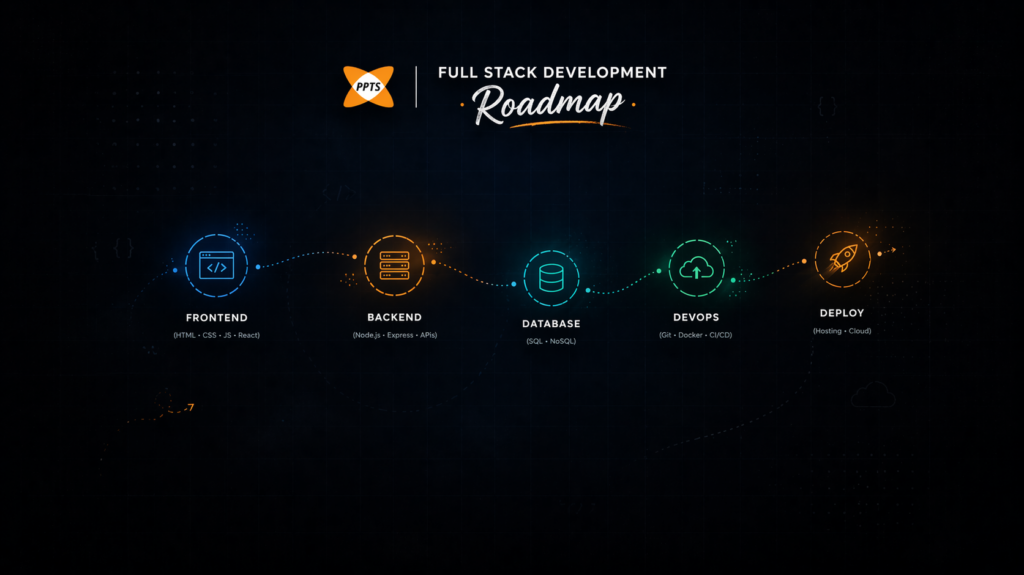
Full Stack Development Roadmap
If you’re wondering how to become a full stack developer, the process is more about consistency than complexity. Instead of trying to learn everything at once, focus on building skills step by step.
Start by learning the basics of frontend development, including HTML, CSS, and JavaScript. Once you’re comfortable, move on to a frontend framework to build dynamic interfaces. The next stage involves backend development, where you learn how servers, APIs, and databases work together.
As you progress, building real-world projects becomes essential. These projects help you understand how full-stack systems function in real scenarios and improve your problem-solving skills. Over time, you can explore advanced topics like cloud deployment, microservices, and performance optimization.
Full Stack vs Frontend vs Backend Development
Choosing between full stack, frontend, and backend development depends on your interests and career goals. Each path offers unique advantages, but full-stack development provides a broader perspective.
Role | Strength | Ideal For |
Full Stack | Versatility | Startups, dynamic roles |
Frontend | UI/UX expertise | Design-focused work |
Backend | System performance | Data-heavy applications |
Full-stack developers are often preferred in environments where flexibility and quick execution are required, while specialists are valued for deep expertise in specific areas.
Modern Web Development Technologies
The field of full-stack web development is constantly evolving, with new tools and frameworks shaping how applications are built and deployed. Staying updated with modern web development technologies is crucial for long-term success.
Frontend development has shifted towards component-based frameworks and performance optimization, while backend development is increasingly adopting microservices and serverless architectures. Cloud computing and containerization tools have also made deployment faster and more reliable.
These advancements allow developers to build applications that are not only scalable but also highly efficient and user-friendly.
Conclusion
Full-stack web development is more than just a combination of frontend and backend skills, it is a complete approach to building modern digital solutions. By understanding how different layers of a web application interact, developers can create systems that are efficient, scalable, and user-centric.
For aspiring developers, the journey may seem complex at first, but with the right roadmap and consistent practice, it becomes manageable and rewarding. For businesses, investing in full-stack development ensures faster execution, better coordination, and long-term scalability.
As technology continues to evolve, full-stack web development will remain a critical skill, bridging the gap between design, functionality, and performance.